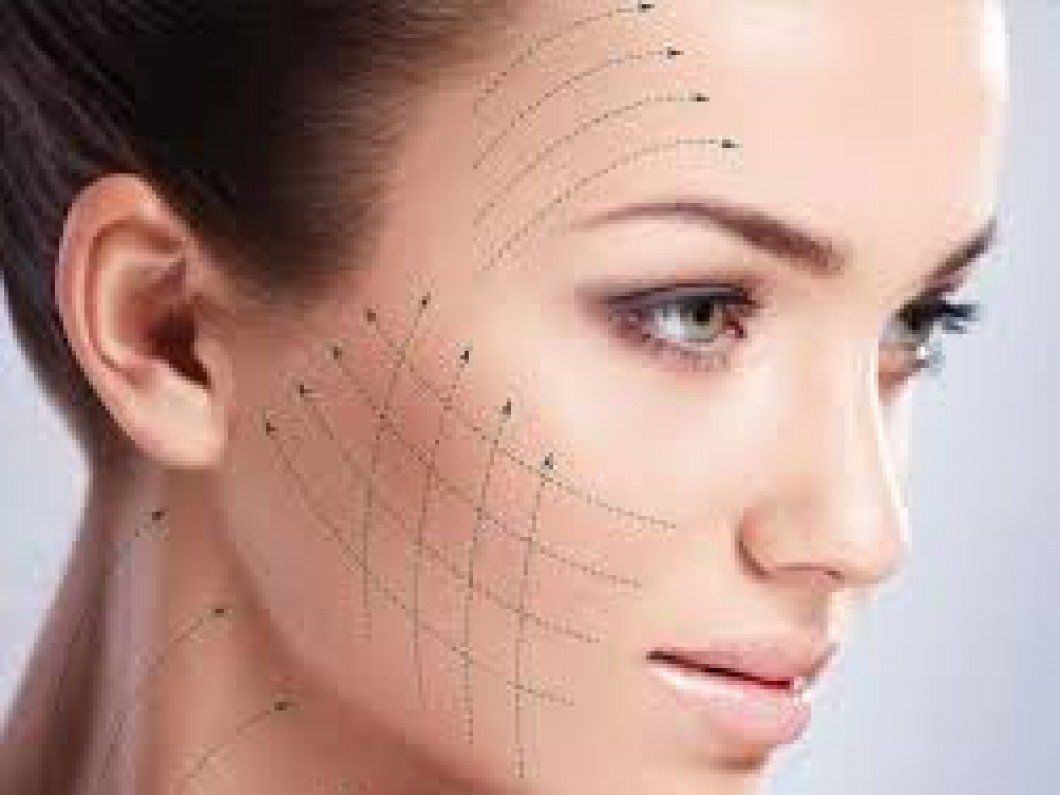
Sub-Dermal Structural Suspension & Bio-Stimulatory Thread Lifting | Manasquan NJ
Vector-Based Fascial Architecture, Barbed Micro-Suspension
& Neocollagenesis
As facial aging progresses, gravity and deep fat-pad descent combine with loss of skin elasticity, resulting in jowls, deep nasolabial folds, and submental laxity. Attempting to lift heavy, descending tissues solely with dermal fillers often leads to an overfilled, distorted appearance.
Directed by Dr. Corina Ianculovici, a post-doctorally educated clinician with fellowship training in Anti-Aging, Functional, and Regenerative Medicine, our sub-dermal structural suspension protocols reposition descended facial fat pads along anatomical vectors. By deploying medical-grade polydioxanone (PDO) vectors and Silhouette InstaLift® PLLA/PLGA micro-suspension cones, we provide immediate mechanical repositioning while inducing continuous Type I and Type III neocollagenesis—achieving a defined jawline, midface lift, and tissue resilience without surgery.
The 4 Clinical Pillars of Structural Suspension
- Vector-Oriented Barbed PDO Lifting: Barbed and molded polydioxanone (PDO) sutures engage the superficial musculoaponeurotic system (SMAS) envelope through micro-cannulas. Descended malar fat and lower-face jowls are mechanically anchored and elevated along anti-gravity vectors, immediately restoring a youthful high-cheekbone contour.
- Silhouette InstaLift® Micro-Suspension Technology™: Featuring bio-absorbable Polyglycolide/L-lactide (PLGA) sutures with bidirectional micro-cones, InstaLift® provides dual-action restoration: immediate mid-face tissue elevation paired with localized poly-L-lactic acid (PLLA) collagen stimulation that builds natural dermal thickness as the sutures absorb.
- Smooth & Twist Mono-Threads for Dermal Redensification: Beyond lifting, smooth and twisted mono-threads act as micro-scaffolds in regions of dynamic crepiness, such as accordion smile lines, submental laxity, and neck bands. These stimulate micro-vascularization and dense collagen banking from within the dermis.
- Biocompatible Resorption & Sustained Collagen Architecture: Polydioxanone and PLGA sutures naturally break down through safe enzymatic hydrolysis over 6 to 9 months. During resorption, your body replaces the suture tract with an organized band of native collagen and elastin fibers, sustaining structural support for 12 to 18 months.