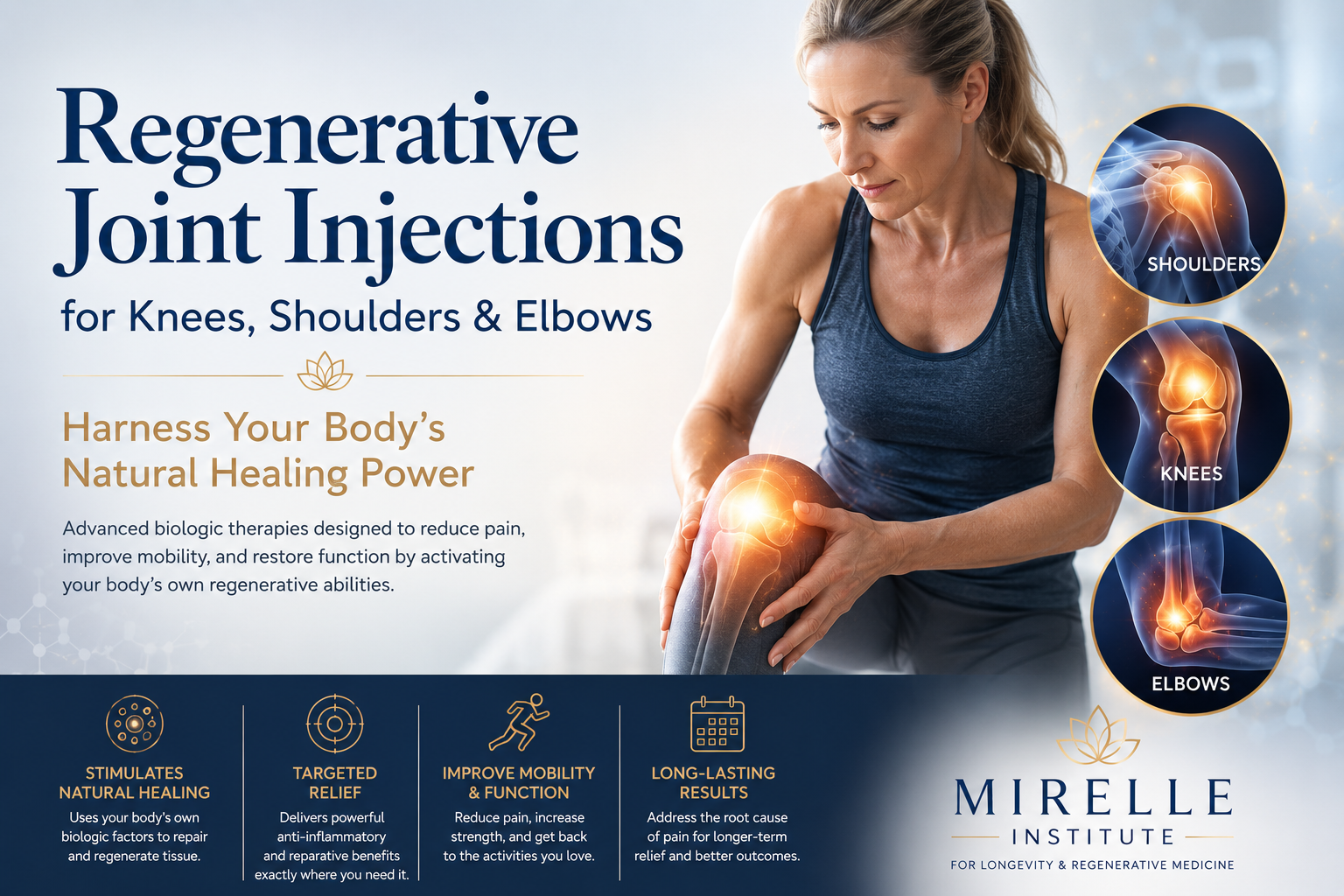
Autologous PRFM Regenerative Joint Injections
Advanced Orthobiologic Restoration for Knees, Shoulders & Elbows | Manasquan & Wall, NJ
Chronic joint discomfort is rarely just an isolated structural issue, it is an inflammatory cascade that impairs systemic mobility, accelerates muscle loss, and degrades healthspan. Led by Dr. Corina Ianculovici, DNP, FAAMFRM, ABAARM-HP, AGNP, Mirelle Institute for Longevity & Regenerative Medicine provides next-generation Platelet-Rich Fibrin Matrix (PRFM) orthobiologic therapies. By concentrating your body’s autologous growth factors within a protective, slow-release fibrin scaffold, PRFM resolves chronic synovial inflammation, supports soft tissue remodeling, and restores pain-free functional movement without corticosteroid degeneration or invasive joint surgery.
The Orthobiologic Evolution: Why PRFM Outperforms Standard PRP & Cortisone
PRFM vs. Cortisone: Corticosteroid injections provide rapid, temporary symptom numbing at the expense of accelerating cartilage breakdown, weakening tendon tensile strength, and increasing long-term joint degeneration. PRFM delivers no synthetic drugs; it activates your body's intrinsic cellular repair pathways.
PRFM vs. Standard PRP: Traditional Platelet-Rich Plasma (PRP) causes an immediate, chaotic burst of growth factors that clear from the joint capsule within hours to days. PRFM converts autologous platelets into a stable, 3D cross-linked fibrin matrix. This protective scaffold shields viable growth factors (PDGF, TGF-β, VEGF) and delivers a sustained, 7-to-14-day continuous biological release, maximizing tissue contact and collagen synthesis.
White-Blood-Cell Poor Precision: Our closed-system centrifugation isolates high-density platelets while stripping out pro-inflammatory red blood cells and excessive neutrophils, preventing post-injection inflammatory flares.
Clinical Indications We Treat
Knee Joint Protocols: Mild-to-moderate osteoarthritis (grades I–III), degenerative meniscal strains, patellar tendinopathy, chronic bursitis, and persistent post-activity synovial effusion.
Shoulder & Rotator Cuff: Supraspinatus and infraspinatus partial-thickness tears, subacromial impingement, chronic bicipital tendinitis, and adhesive capsulitis mobility deficits.
Elbow & Forearm Tendinopathies: Refractory lateral epicondylitis (tennis elbow), medial epicondylitis (golfer's elbow), and collateral ligament micro-strains.
The Mirelle Dual-Protocol: Biologics + Neuromuscular Stabilization
Joint recovery cannot succeed if the surrounding musculature remains weak and unstable. At Mirelle Institute, we uniquely pair orthobiologic PRFM injections with AccuFit® targeted neuromuscular activation:
- Biological Repair (PRFM): Calms intra-articular inflammation, enhances synovial lubrication, and stimulates local cellular repair.
- Structural Reinforcement (AccuFit®): Electronically conditions the stabilizer muscles (quadriceps/gluteals for knees, rotator cuff/scapular stabilizers for shoulders) to decompress the joint space and protect newly regenerated tissue long-term.
Restore Mobility. Reclaim Function. Avoid Surgery
Experience personalized, clinician-administered orthobiologic care tailored to your active longevity.
Schedule an orthobiologic evaluation at our Manasquan clinic.
Frequently Asked Questions: Orthobiologic PRFM Joint Injections
Q: How does PRFM differ from standard PRP and cortisone injections?
A: Corticosteroid shots temporarily numb pain while accelerating cartilage degeneration and weakening tendon tensile strength over time. Standard Platelet-Rich Plasma (PRP) introduces growth factors that disperse and wash out of the joint within 24 to 48 hours. Platelet-Rich Fibrin Matrix (PRFM) utilizes a proprietary gel matrix that traps viable platelets within a three-dimensional fibrin scaffold, delivering a steady release of regenerative growth factors directly to damaged joint tissues for 7 to 14 days.
Q: Which joints can be treated with PRFM orthobiologics at Mirelle Institute?
A: Dr. Corina Ianculovici treats mild-to-moderate osteoarthritis (grades I–III), degenerative meniscus fraying, and patellar tendinopathy in the knees; partial-thickness rotator cuff tears, subacromial impingement, and chronic bursitis in the shoulders; and refractory lateral or medial epicondylitis (tennis and golfer's elbow) in the elbows.
Q: What is the recovery downtime following a PRFM joint injection?
A: Downtime is minimal because PRFM is autologous—derived entirely from your own blood—which eliminates the risk of allergic or foreign-body rejection. You may experience mild stiffness or localized aching for 24 to 48 hours as the biological cascade activates. Most patients resume routine daily activities immediately, while refraining from heavy, high-impact athletic loading for the first week.
Q: How many PRFM joint treatments are required, and when do results appear?
A: Most joint protocols involve a series of 1 to 3 targeted sessions spaced 4 to 8 weeks apart, depending on baseline joint space narrowing and tissue wear. Because PRFM works through biological remodeling rather than artificial pharmaceutical numbing, progressive improvements in pain relief, joint smoothness, and range of motion typically begin within 3 to 4 weeks and continue to build over several months.
Q: Why does Mirelle Institute combine PRFM injections with AccuFit®?
A: Regenerating cartilage and tendon fibers cannot provide lasting relief if joint mechanics remain imbalanced. Pairing PRFM with AccuFit® targeted neuromuscular activation strengthens and re-educates the surrounding stabilizer muscle groups (such as the quadriceps and glutes for knee stabilization or the rotator cuff for shoulder tracking), decompressing the joint space and protecting newly healed tissue.






